Family Expectations | Feature Update Version 1.1

With 1.0, I wanted parents to have their own expectations and react differently to what their children do. And with 1.1, I wanted to explore the other side of that: how does the child feel about all of it? What happens when they have spent "years" trying to please a parent? What if they finally stand up for themselves? What if their sibling takes their side, or their parent actually changes?
That's really what this update is about. New features, include trust, childhood history, university conversations, promises, gifts, sibling support, and a Breaking Point system. A lot of these features connect to each other, so the choices you make can continue affecting a family later on.
One thing to know before getting into it: the new family conversations, decisions, promises, and gifts are player-controlled. Automatic life-event reactions and moodlets still work as they did in 1.0. The one exception is that a parent you are not currently playing can fulfill an earned promise automatically.

What's new in 1.1?
University: parents react to university milestones, and Sims have new conversations about their studies.
Childhood History: the mod keeps track of what growing up with each parent was like.
Something to Prove: some Sims use criticism as motivation instead of letting it defeat them.
Breaking Point: overwhelmed children can finally confront the parent putting pressure on them.
Making Peace: adult Sims can work through a difficult relationship after a parent's death.
Trust: children develop their own opinion of each parent, separate from the parent's approval.
Money Talks: proud parents can send money to celebrate milestones, and children can accept or reject it.
Parents Talking: parents discuss their children with each other, friends, and relatives.
Promises: parents can promise rewards for achievements, then keep or break their word.
The Last Word: a parent's approval and the child's trust affect how their death is remembered.
Sibling Solidarity: siblings can support one another or take a parent's side.
A Life Without Children: adult Sims can tell a parent they don't plan to have children, or any more children.
Below I've explained what each feature does, where to find it, and the important conditions to know.
1. University: Your parents have opinions about that too!
If you own Discover University, university is now part of Family Expectations.
Parents who care about Education can react when their child graduates, graduates with Honors, receives a full ride, drops out, or gets back into good standing after academic trouble. And yes, a parent can be much prouder of an Honors degree than an ordinary one.
There are also 7 new university conversations. Parents can ask how university is going or tell their child which subject they hope they'll study. Students can talk about their degree choice, explain a difficult term, talk about graduating, or tell their parent that university isn't in their plans.
For example, a parent might have their heart set on Economics while their child chooses Fine Art. A supportive parent may accept that choice, while a critical one may be much harder to convince. If the student actually chooses the subject their parent wanted, even a harsh parent can be pleased.
Where to find it: Click the parent or student and open Family Expectations → University Talks. The conversations you see depend on who you're controlling and the student's situation. Every conversation requires the parent to care about Education.
A few things to know:
Discover University is required for the university milestones and most university conversations. Without it, University Isn't My Plan is available for eligible teens and older Sims whose parent strongly expects Education.
A student on probation or suspension can use Explain a Difficult Term, but probation and suspension themselves don't trigger automatic parent reactions. They can be triggered manually through Storyteller Tools.
University soccer/e-sports Sims who go pro are treated as dropping out of their degree, not as receiving a normal career promotion.
Some university news may arrive after travelling or on the next loading screen if the student isn't on the lot you're playing. Graduation and full-ride news won't keep repeating.
University conversations can also change Trust, create Something to Prove, or lead to a gift or promise being fulfilled later.

2. Childhood History: Growing up leaves something behind
This is one of the additions I really wanted to make because pressure shouldn't only matter in the moment.
The mod now remembers how much pressure a Sim experienced while growing up with each parent. A child who grew up with a warm, encouraging parent can have a very different experience from one who was constantly being pushed or criticized.
Each parent-child relationship can have one of four upbringings:
Upbringing
What it generally means
Easy: Mostly warm or low-pressure
Trying: Some difficult expectations
Hard: A lot of pressure over the years
Crushing: A particularly difficult childhood
Pressure during childhood counts more heavily than it does during the teen years. It also hurts more if the child was already Crushed by Expectations. Having another Supportive or Unconditional parent in their corner can soften the effect.
Kindness during the teen years can help too praising them, encouraging them, easing expectations, apologizing, or listening when they speak up. But it doesn't completely erase what happened earlier.
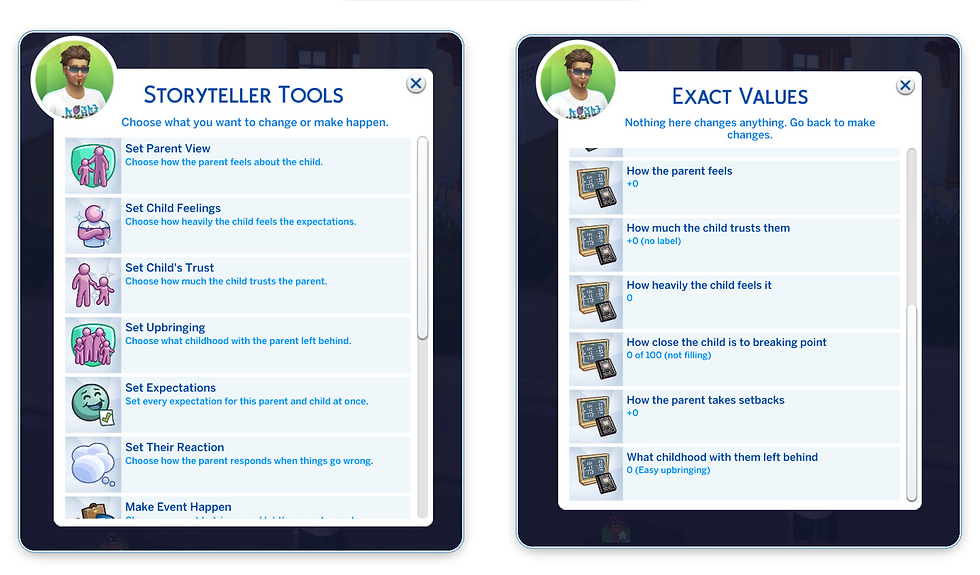
Where to see it: Open Storyteller Tools → Exact Values and look for What childhood with them left behind. You can also use Set Upbringing if you're making a particular story.
Important: This only builds while a Sim is a child or teen. Sims who were already adults when you installed 1.1 start with an Easy upbringing. It doesn't fade on its own.
A Hard or Crushing upbringing can become important again much later, including after that parent dies.

3. Something to Prove: Not every Sim responds to criticism the same way
Some Sims are deeply hurt by their parents' disappointment. Others get angry and decide they're going to prove them wrong.
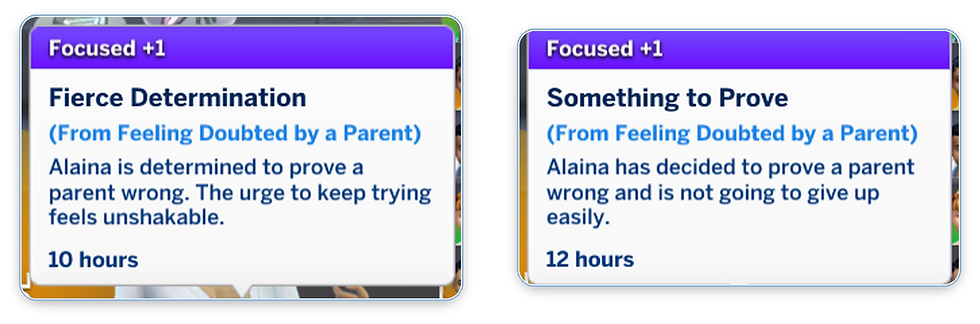
With Something to Prove, certain teens and older Sims can turn an especially hurtful interaction into motivation. For a while, they learn skills faster and improve at work or school more quickly.
This can happen after being written off, compared to a sibling, dismissed during an argument, becoming a parent's Black Sheep, or choosing to Rebel at Breaking Point.
The Sim needs the right kind of personality. Traits like Ambitious, Self-Assured, Hot-Headed, and Independent are among the ways it can happen. If you own Parenthood, Growing Together, or High School Years, some traits, phases, and family dynamics from those packs can contribute too.
There are different strengths, from Something to Prove to Fierce Determination. A particularly harsh parent, a close relationship, or a fiery personality can make that determination stronger.
How long does it last? 12 Sim hours. Stronger versions can replace weaker ones. Your Sim might still feel Sad or Angry at the same time; the motivation boost still works.
You don't need to click anything to trigger it. It's a reaction to what the Sim has experienced, and it won't happen to every child.
4. Breaking Point: When it finally becomes too much
If a child or teen stays Crushed by Expectations for long enough, they can eventually reach At Breaking Point. It takes roughly 4 Sim days of continued crushing pressure, so it isn't something that should happen after one bad conversation.
When they reach that point, you can decide what they do about it.
Where to find it: Control the child or teen, click them, and choose Deal With the Pressure. Pick the parent they want to confront. The option only appears when they have At Breaking Point and there's an eligible parent to face.
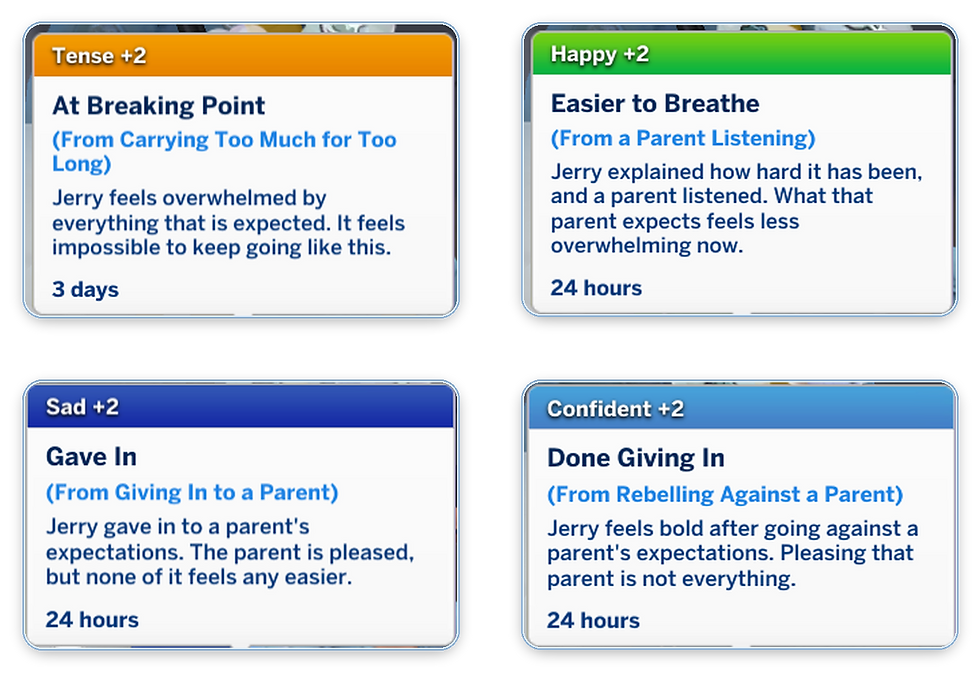
The child can try to Talk to Them. If the parent listens, a lot of pressure is lifted and the child's trust grows. If they refuse to listen, things can get worse, and you get another choice:
Give In: The parent is pleased, but the pressure remains and the child trusts them a little less.
Rebel: The child takes a stand, relieving a lot of pressure but damaging the parent's approval and the child's trust. For some Sims, this can also trigger Something to Prove.
Not Now: Leave things as they are and try again later.
Whether the parent listens depends heavily on their reaction style, but their relationship, traits, approval, and the child's trust matter too. A Supportive or Unconditional parent is much more likely to listen than a Critical or Harsh one.
Important details:
The parent must be alive, not paused, and contributing at least 50 pressure (Weighed Down or Crushed). If more than one parent qualifies, the child can confront them separately.
At Breaking Point lasts 3 Sim days if you don't act. If the pressure stops, the build-up gradually goes away over roughly 3 Sim days.
The outcome moodlets last 1 Sim day.
You can see the build-up under Storyteller Tools → Exact Values → How close the child is to breaking point.
This can affect approval, Trust, the child's upbringing, and even which sibling is considered the Golden Child or Black Sheep.
5. Making Peace: Even after a parent is gone
I also wanted to include something for Sims who grew up with a difficult parent but never really got closure.
A young adult or older Sim with a Hard or Crushing upbringing can work through those feelings after the parent or step-parent has died.
There are three ways to do it:
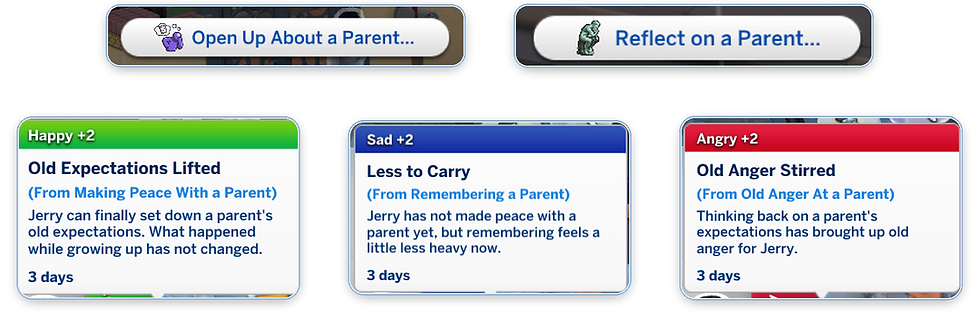
Reflect on a Parent: Click your active Sim, then Actions → Reflect on a Parent.
Open Up About a Parent: Talk to an eligible close friend or family member through the Family Expectations menu.
Let Go of Hurt From [Parent]: Click the parent's grave or urn.
They can choose to go to their parents grave or by opening up to someone close leads to peace. Reflecting alone can go differently: the Sim may find peace, feel a little lighter, or end up bringing some old anger back to the surface.
If they find peace, they receive Old Expectations Lifted, and the pressure they still carry from that parent disappears. Anger can instead bring back Something to Prove for certain Sims.
The conditions: The child must be a young adult or older, the parent must have died, their upbringing must have been Hard or Crushing, and they must not already have made peace. A paused relationship doesn't qualify.
The moodlets last 3 Sim days. If the Sim isn't ready to make peace, you can try again; once they have made peace, that stays with them.
One limitation worth mentioning: the game may eventually remove deceased Sims who are no longer played, so the option can disappear if that happens. Keeping the ghost in the household prevents that.
6. Trust: Children have their own opinion of their parents
In 1.0, we had Approval, which represents how a parent feels about their child.
Now we also have Trust, which represents how the child feels about the parent. I initially wanted to add it to the first launch but I wanted to test out the first features first.
A parent might be incredibly proud of their child, but that doesn't automatically mean the child feels close to them or trusts them. Likewise, a parent can be disappointed while the child still sees them as someone they can turn to.
Trust develops through experiences: encouragement, being listened to, promises being kept, hurtful comparisons, arguments, and all kinds of other family moments.
Trust label
What it means
My Safe Place: They feel safe turning to this parent
Can Lean on Them: They trust this parent to support them
No label: Somewhere in the middle
Feels Judged: They expect criticism or judgment
No Trust Left" They no longer feel they can rely on this parent
Everyone starts in the middle. Trust doesn't automatically improve or worsen with time it changes because something happens between the Sims. Ordinary kindness helps, but reaching My Safe Place takes a more meaningful moment, like a parent really listening when their child reaches Breaking Point. Once they reach my safe place you find it as a relationship bit.
Where to see it: On the child's relationship panel with the parent, or under Storyteller Tools → Exact Values. You can also change it manually through Set Child's Trust.
Trust matters throughout the update. It can affect whether a parent listens, how a child responds to a gift, and even what they feel when that parent dies.

7. Money Talks
Proud parents who live in another household can now celebrate certain achievements by sending their child money.
This can happen after a university graduation, a marriage, the child's first baby, or reaching the top of a full career.
Where to find it: Control the parent and select Actions → Send a Gift. The option appears when the parent has an eligible reason to celebrate.
They can choose to send §1,000, §5,000, or §10,000, as long as their household can afford it. The money goes directly from the parent's household to the child's household.
But the interesting part comes afterwards.
Some time later, the child may receive a call. If you're playing the child's household, you can choose to Keep It and Say Thanks or Send It Back (as long as the household still has the full amount). If you're playing the parent, the child makes that decision themselves.
Trust plays a big role here. A child who feels safe with their parent is more likely to appreciate the gift. One who has been hurt by that parent may want nothing to do with their money.
The parent must live separately, care about the relevant expectation, have at least 15 friendship with the child, and be Proud or Devoted after hearing the news.
The opportunity lasts 3 Sim days after the good news.
The call normally comes 6–24 Sim hours after sending the money, during the day, and may retry if the Sim isn't available. It expires after 7 Sim days.
A disappointed parent may send no gift at all, and the game can acknowledge that too.
This money doesn't count as money the child earned toward Financial Success milestones.
A thank-you strengthens Trust. Returning the gift can leave the parent hurt and less approving.

8. Parents Talking: Families talk about each other
This one adds more conversations between the adults and other family members, rather than everything happening directly between a parent and a child.
Parents can Discuss Our Child and Compare Hopes. They might agree, compromise, stand by their opinions, or end up arguing. They can also Boast About a child they're proud of or Vent About one they're disappointed in.
And children can now Complain About a Parent to another parent or step-parent.
That last one is especially interesting to me because the parent listening might actually take the child's side. If they do, they become a little warmer in how they handle setbacks going forward. Or they might defend the other parent and leave the child feeling unheard.
There's also a possibility of gossip getting back to the child. If a parent vents to the child's sibling, that sibling can choose to use Tell [Child] What [Parent] Said. The child may not be very happy to hear it, and their Trust can fall. Or you can decide that the sibling keeps it to themselves.
Where to find it: Click another Sim and look in the Family Expectations menu for Discuss Our Child, Compare Hopes, Complain About a Parent, Boast About, or Vent About. The options depend on who is talking, their relationship, and how they feel about the child.
Some important conditions:
Discuss Our Child and Compare Hopes require two adult parents/step-parents of the same child who live together or are married/engaged.
Complain About a Parent needs a child or teen who has another parent putting pressure on them or feeling disappointed in them.
Boasting needs a Proud or Devoted parent; venting needs a Disappointed or Given Up parent. The listener must be family or a friend with at least 15 friendship.
Sibling gossip can be passed along for 2 Sim days after the conversation. You decide whether to tell.
These conversations have the usual 3 Sim hour cooldown for the same pair. They can affect parental approval, friendships, Trust, and even the parent's reaction style over time.

9. Promises: Parents can make promises, and break them
I really like this one because it's a small thing that can have a lasting effect on a child's relationship with their parent.
A parent can promise something in exchange for their child doing well. Maybe good grades earn a new computer. Maybe a promotion earns a shopping spree. Maybe the parent simply promises that they'll finally be proud.
Where to find it: Control the parent, click their child, and open Family Expectations → Promises.... For a child living elsewhere, you can keep or take back a promise through the parent's Actions menu.
Rewards include money (§1,000, §5,000, or §10,000), gifts like a TV or computer, outings, and a promise of pride. Some outings are age-specific: sleepovers and movie nights for children/teens, and parties or nights out for teens.
When making the promise, you choose what the child needs to accomplish something in school, work, relationships, having children, or finances. Only areas the parent cares about will appear.
Once the child achieves something in that area and the parent hears and reacts to the news, the promise becomes due. Now you get to decide whether the parent follows through.
Keep the Promise: The child gets A Promise Kept, and their Trust grows.
Take Back a Promise: The child gets A Promise Broken, and their Trust falls.
A parent and child can have one promise at a time. If the menu is greyed out, they already have one open or due.
Promises have no deadline. A due promise stays there until it's kept or taken back.
If the child lives with the parent, a promised physical gift or outing is something you roleplay; the mod does not automatically buy a TV or organize a holiday.
For a child in another household, promised money transfers between households, and some physical-gift promises are represented by money toward the item.
A parent you're not currently playing can keep a due promise automatically. If they can't afford it, the promise breaks.
You can see the current promise under Storyteller Tools → Exact Values.
Kept or broken promises matter for Trust and can also affect Approval.

10. More Family Moments
The Last Word
When a parent dies, their child can now receive an additional moodlet based on their relationship. How the parent felt about them and how much the child trusted them both matter.
A child might feel comforted knowing their parent was proud of them, regret never making them proud, or have mixed feelings about a parent they loved but couldn't fully trust.
This happens automatically alongside the game's normal grief, and the moodlet lasts 2 Sim days.

Sibling Solidarity
Siblings can now talk about their parents' expectations through Family Expectations → Talk About Our Parents.
One sibling can offer support, take the parent's side, or choose not to get involved. Depending on the choice, they may grow closer, damage their relationship, or help relieve some of the pressure.
This interaction is available to eligible teen and older siblings who share a living parent with expectations set.

A Life Without Children
Not every Sim wants children, even when their parents are hoping for grandchildren.
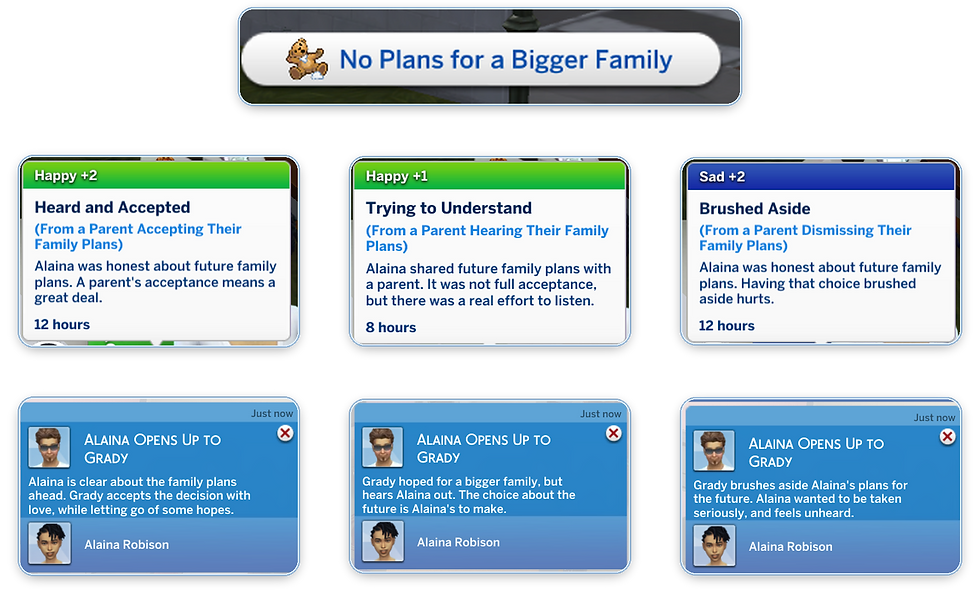
Young adults and older can now use No Plans for a Bigger Family to explain that they don't want children or don't plan on having any more.
How the parent responds depends on their personality and relationship with the child. They might accept the decision, try to understand, or dismiss it entirely.
An accepting parent can significantly relieve pressure, improve Trust, and even permanently lower their expectation about having children by one level.
New Storyteller Tools and where to find things
I've added several options to Storyteller Tools so you can create the family story you want without waiting for every situation to happen naturally.
You can now Set Child's Trust, Set Upbringing, check how close a child is to Breaking Point, see promises in Exact Values, and manually trigger the new university events through Make Event Happen.
To get there from the parent's side: click the active parent → Actions → Family Expectations → [Child] → Storyteller Tools. You can also access it from the child's parent screens.
Most interactions between Sims are still in the Family Expectations menu when clicking another Sim. Actions you perform on your own Sim, such as Reflect on a Parent, Send a Gift, or managing a promise for a child in another household, are under Actions. Deal With the Pressure appears directly on the child or teen when they're at Breaking Point. Making peace at a grave uses the grave or urn's own menu.
Other small improvements
There are a few smaller fixes and quality-of-life changes in 1.1 as well:
Parents now say another grandchild when appropriate, rather than acting as though every grandchild is their first.
Make Event Happen gives a clearer explanation when nobody reacts.
Some unavailable interactions show a helpful greyed-out explanation instead of disappearing, including options that require a teen or older child.
A one-time Family Expectations: Installation Issue message can tell you when the mod or Lot 51 Core isn't loading properly.
Step-parents you've used the mod with can continue to count after divorce or a parent's death, as long as the game keeps that relationship.
The Family Expectations self-menu no longer appears on babies or toddlers, although parents can still set expectations for them.
Set Parent View and Set Child Feelings now identify the currently selected option.
Public Nov 28th


Comments